Showing posts with label Argentina. Show all posts

Monday, 4 August 2014

So Argentina defaults again.


So Argentina defaults again.

Despite the headlines this is generating, the sun will continue to rise, the inhabitants of Buenos Aires will continue to enjoy the world’s best steaks, and tourists will still flock to Evita's tomb.

Countries don’t have a “right” to default, but sometimes it is the only option. In an ideal world, they swiftly reach an agreement with their creditors, who recognize the reality of the situation, everyone learns their lessons, and move slowly forwards, chalking it all up to “experience”

Unfortunately we don’t live in an ideal world. As we saw with the Euro Crisis, Governments leave it far too late to publically admit that they need bailing out even when it is perfectly obvious that they need to.

As I have mentioned before, I remember some of the roadshows for Argentine bond issues during the run-up to the crisis, and private meetings I had with the Ministry of Finance in Argentina, where the economic projections were a work of fiction. Following the Russian default of ’98 and the Brazilian devaluation of ’99, Argentina’s de-pegging was a matter of when not if.

What made the situation worse was the attitude the Argentine Government took to the restructuring. After years of posturing and nationalistic chest thumping, the late President Nestor Kirchner announced on Primetime TV, “this is the deal, take it of leave it”. To underline the point, he included a law prohibiting any reopening of negotiations with any party who didn’t participate in the restructuring. Argentina is now paying the price for his hostility.

The public faces of the dispute are the Vulture Funds, such as Elliot Capital. It is a very apt term, even though it is supposed to be an insult, as no one else is really going to get involved until the vultures have given the body a good picking over; they reassure the rest of us that some kind of bottom has been reached. Indeed, the papers on Friday were full of stories of hedge funds buying the Argentine stock market directly, now that all the bad news is in the price. My clients own some Argentina through the Frontier Markets ETF (FM.N)

The Vulture Funds, however, are not the only interested parties in the court case. A lot of bonds were originally sold in Europe, where people often buy such bonds as part of their retirement planning. As you can see from the two charts below, in the early 90’s the spread of Argentine bonds over US treasuries was narrower than the spread of Italian Government bonds over German Bunds, suggesting they were considered a less speculative investment. It was only the prospect of Euro inclusion that brought Italian yields down. As a result approximately 2/3 of the holdout investors, by value, are small time investors, mainly from Italy.


To all intent and purposes, the Bond markets closed to Argentina after their take-it-or-leave-it restructuring. A more reconciliatory attitude would have kept them open, but that wasn’t the Kirchners’ problem. They have tried to dress it up in terms of nationalist chest thumping, but the reality is they themselves were not inconvenienced by the problems of the ordinary people as they became even wealthier. They happily “lead the people” against the depredations of Foreign Creditors and the IMF without worrying about spiraling unemployment or 30% inflation.  The Government squandered huge windfalls from higher agricultural commodity prices, and stole all the assets from the private Pension Fund system just to keep afloat.

In about 2006 the late President Kirchner fell for the charms of Hugo Chavez, borrowing dollars from him at about 15%. This at a time when the markets were charging Brazil 5.5%, and the IMF was charging 2-3%. Unfortunately for Argentina, Chavez immediately dumped the bonds into favoured Venezuelan banks, which in turn promptly dumped them onto the market to earn precious dollars. The Argentine treasury found itself having to intervene in the market to buy back the bonds with the money Chavez had “leant” them in order to stop their remaining debt spiraling downwards.

I was building a bond portfolio for some clients using ETFs recently. In anticipation of this “default”, I double-checked the Argentina content of the major EM Bond ETFs, and got a number of around 1%. Even I was surprised how irrelevant Argentina had become.

That is the bottom line now Argentina doesn’t matter. They have so ostracized themselves, that no one has the level of investments there that is going to require any significant attention. Whether Inflation is 25% or 30% isn’t going to be changed by this week’s events, GDP growth will be relatively unaffected; meanwhile, over in Nigeria …

What of the future? Is there any kind of solution to this charade?

According to the papers, approximately $1BN in credit default payments have been triggered, versus about $4BN in debt holdouts. Is that enough to push the holdouts to accept the original offer? Obviously that depends on who holds what, but one of the better conspiracy theories I have heard recently is that the whole negotiation is a giant Kabuki Play to justify the triggering of those CDS, and that the Holdouts can now accept a lower offer once the no-renegotiating clause expires at the end of this year.

So my feeling is Argentina is moving into the end game here. Christina Fernandez’s time as President runs out next. Rampant double-digit inflation is giving the population more pressing concerns to worry about than the holdouts from 2001, whilst the new President will have less emotional attachment to “punishing” Argentina’s creditors


So this little spat is going to rumble on a little bit longer. It may create some headlines, but the reality is no one really cares any more.

Monday, 24 February 2014

More on Latin America's protests


Following last week’s comments about protests in Venezuela, I got an email from Christian Novak chiding me for not taking my analysis farther and discussing whether the eventual collapse of the Maduro regime will have a knock on effect on other Latin American countries, such as Argentina, Bolivia, or Peru.

Guilty as charged.

President Christina Fernandez in Argentina is already on her way out. Last October’s elections did not give her the mandate she needed to change the constitution and run for a third term. Fernandez never militarized the economy the way Chavez did, whilst all her mistakes are homegrown; there are no foreign advisors, Cuban or otherwise. Neither the IMF approved reforms to the national inflation indices nor the settlement with Repsol over YPF would not be possible without her approval, stated or otherwise.

Collapsing foreign exchange reserves seem to have done an excellent job of concentrating Fernandez’s mind. Neither the IMF backed reforms to the national inflation indices nor the settlement with Repsol over YPF would not be possible without her approval, stated or otherwise, and she would only do so if she had no other choices. Argentina’s lack of a developed Energy industry to underwrite her excesses meant she was never able to push her nationalism as far as Chavez did, despite all the rhetoric and joint issuance of bonds.

Peruvians have been much harder on President Humala than Venezuelans were on Chavez. Lacking Chavez’s charisma, his popularity slumped as the economy slowed last year. Chavez was able to put many of his cronies into positions of authority where they could seek rents unopposed, whilst Humala’s attempts to do likewise were immediately met by street protests, forcing him into a humiliating climb down.

Unlike in Venezuela, Bolivia’s Evo Morales has used the commodities boom to accumulate Foreign Exchange reserves to insulate the economy from the inevitable fall in prices, so reserves/ GDP are now amongst the highest in the world. Whereas debt/ GDP is at record levels in Venezuela (when you factor in the Chinese Oil loan and the Government’s unpaid bills), it has fallen dramatically in Bolivia. Where he has nationalized an industry, Morales has ensured that they continue to invest back into the business and remain competitive.

None of these three countries are dependent on Venezuela in any form, so a change in Government in Venezuela is not going to cause them any hardship. Despite all their fraternal leftist rhetoric, what they have actually done in practice is qualitatively different to what Venezuela has done. Any future policy changes will be independent of any changes in Venezuela.

The one country where a material change in Venezuelan policy will impact them is Cuba. The presence of so many Cuban “advisors” in the country is being increasingly questioned, and is a source of tension. This video posted to Youtube shows the arrival of another planeload of Cubans at Caracas airport being told to “Get lost!”


Currently the island receives an unknown but significant amount of cheap oil. As Venezuela’s oil revenues shrink, it will be harder and harder to maintain these subsidies, and a less accommodative government in Caracas could be as disruptive to Havana as the fall of the Berlin wall.

----------------------------------------------------------------------------------
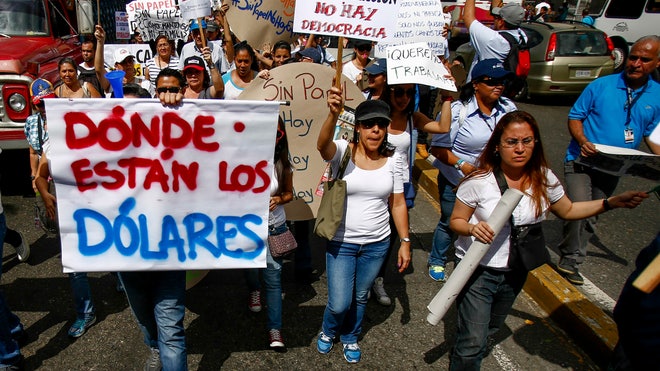
Over the weekend, some of Venezuela’s protestors tried to link what they are doing to events in the Ukraine, but the differences are probably greater that the similarities; the demonstrations in Ukraine appear to be more broadly based than in Venezuela, with a more focused leadership. The protestors in Venezuela are still seen as being predominantly Middle-Class, without clearly defined goals. Having said that, the numbers attending the anti-Maduro marches are impressive - see the picture at the top.

Finally, Colgate Palmolive announced that they would take a one-off loss of $180-200M on Venezuela’s latest devaluation. I include this little tidbit not because it refers to Venezuela, but to emphasize the increasing role Emerging Markets play in the profitability of global multinationals.


Sunday, 16 February 2014

Protests in Latin America.


This week saw three major developments in Latin America; in alphabetical order, Argentina finally produced a meaningful inflation index, Brazil officially slipped into a recession, and at least two people were killed in student protests against the Government in Venezuela.

There is a tragic inevitability about the protests in Venezuela; as the Government has radicalized and demonized any who don’t support it, they have left those who have genuine grievances nowhere to express their views in a peaceful manner. At the same time, the continued and extensive shortages of basic goods, from foodstuffs like flour to necessities like toilet paper are leaving people increasingly frustrated and disenchanted.

Toyota recently joined the long list of those cutting back on their Venezuelan operation when they announced that they would no longer be assembling vehicles in the country. The lack of dollars means that their just-in-time inventory management simply does not work, and even old-fashioned stock management is problematic because there is no way to plan stocks since there is no way of knowing when dollars will be available. In the unlikely event dollars do become available, there is no way of knowing at what exchange rate they can be bought, and at what exchange rate the finished product can be sold. Meanwhile, official waiting lists at car dealerships are apparently years long.

Unfortunately Maduro’s position is too weak for him to compromise. There are many within his own party, such as Diosdado Cabello, who are waiting for the right time to push him aside His weakness is forcing him to be “more Chavez than Chavez”. When faced with the withdrawal of firms like Toyota or the increasing shortages of basic goods, President Maduro has fallen back on increasingly bellicose rhetoric, but without the humility shown by the late President; when 20 000 tons of food rotted in Government run warehouses during the early days of the food shortages, Chavez was at least able recognized this as a Government problem and to promised to do better. As power cuts have spread into Caracas, Maduro has increasingly railed against “sabotage” by “Fascists” and “Antigovernment interests”.

The events of this week were truly tragic, and probably only the beginning. Please may I be wrong.

Brazil’s recession was equally inevitable. I believe I have nagged you enough about the failure of the current Government to enact any meaningful reforms, whilst they remain transfixed by next October’s presidential elections. There is so much that Finance Minister Mantega could have done to avoid the slowdown, but instead he fell back on the usual tried and failed policies of the past.

The ongoing protest against the World Cup are also directly linked to the weakness in the economy; many of the protestors have made it clear they want to see an improvement in Government services, from education to healthcare, whilst Inflation, although low by historic standards, is seen as a problem.

I believe, and I hope I am not being naïve in this, that the protests in Brazil are about as bad they are going to get. All sides recognized the tragic death of TV cameraman Santiago Andrade as unacceptable, whilst the Government has enlisted Pele to be their PR spokesman for why the World Cup should still take place. The fact that they are even launching such a PR campaign shows that they realize how big their problems really are. Once the games start, Brazil’s love of the beautiful game will replace any resentment over Government policies. It will then be up to the Government to build on that peace rather than squander it like they have squandered so much in recent years.

Argentina has not, as far as I am aware, suffered from the same level of street protests in recent weeks as either Brazil or Venezuela, but I think they are coming.

As I mentioned in the introduction, the Argentine Government has stopped lying about inflation. They have just announced a new index that more accurately tracks price changes, and it even appears to give a higher reading than previous private estimates. The January reading was 3.7% that annualizes out at 50%. Other private estimates were in the range of 25-30%, whilst official numbers were only 10.9% for 2013. They did not, however, rework previous numbers.

The recent devaluation of the peso will cause inflation to accelerate farther just as the Government tries to bring public spending under control. This in turn is likely to lead to conflict between the Government and unions as the Government is forced to backtrack on its “Social Justice” commitments; they have run out of their own money, and their inability to tap international capital markets means they do not have access to other people’s.

There are early signs that the economy is going into recession, if it is not already there – shorter work hours, holidays being brought forwards, possible rising unemployment.

Taking these together, and Argentina’s history of protests, it is highly likely that the erosion of purchasing power and the Government’s inability to fund its programs will bring Argentines out onto the streets in a rerun of the Cacarolazos protests that followed the 2001 financial crisis.

2014 is shaping up to be a noisy year in Latin America.