Showing posts with label Africa. Show all posts

Sunday, 13 April 2014

Does size matter?


Last week Nigeria rebased its GDP to become the largest economy in Africa. It went from $264Bn to $509Bn, an increase of 89%, overtaking South Africa’s $384bn and just ahead of fellow Petro-state Norway’s $499Bn.

Kenya is undergoing a similar exercise, and preliminary estimates suggest their economy is 20% bigger at around $50Bn.

10 years ago, China carried out a major review of GDP that added 16.8% to its GDP, and many commentators at the time “guessed” that they were still underestimating GDP by at least 10%.

It will be interesting to see the effects of Purchasing Power Parity adjustments on these new numbers.

It’s not that these countries have previously been dishonest about their GDP, but that economies change over time and that changes to Government statistics always lag the economy.

When I was a medical student, I was taught “you can’t find a fever without taking a temperature”; you can’t estimate a sector’s growth without first identifying that sector. The census that increased China’s GDP had found $284Bn worth of companies that the central Government did not know existed, mainly in the service sector.

Prior to 1985, China didn’t even calculate but used the system that completely disregarded service industries. Even after they started to calculate it, China didn’t fully adopt GDP until 1993. Incidentally, the former Soviet States didn’t abandon the measure until 1991.

Telecoms, and especially mobile telecoms, are common areas Governments have underestimated GDP. Many countries, of which India is possible the most well known, decided NOT to regulate mobile telecoms in the same way they regulated fixed-line; since the poor would never be able to afford mobile phones, they would never require the same degree of protection!

As we now know, freed from Government protection, consumers were able to get a plethora of “value added” services from their mobile providers – not least actual working lines. In the African context, Kenya’s Safaricom introduced M-Pesa that is often regarded as the world’s most successful mobile payment system. I suspect the upcoming revisions will show a dramatic increase in this category.

The recent revision in Nigeria took Telecoms and IT from 0.9% of GDP to 8.7%! My Nigerian friends tell me that the networks are still highly congested – to put up a cell tower you often need to provide a generator to ensure uninterrupted power and a guard to make sure the generator does not get removed, then fuel for the generator, etc, so the roll out continues to be slower than possible. The dead hand of Government still manages to hold things back.

There were several sectors that were going completely unmeasured. The previously unmeasured entertainment industry that includes Nigeria’s famous Nollywood film industry added an estimated 1% to GDP.

Ironically, the increased size of the economy only goes to show how totally inept the Government sector is. Taxes/ GDP, already low in Nigeria, are now half as much, likewise the power generation deficit is twice what it was!

But let’s focus on the positive.

This “hidden” growth explains why firms like Dangote and the various banks have done so well. They have not been taking inordinate risks, but merely responding to market growth. Some of the revised indicators I am looking to see broken out are various types of loans to GDP as they would show how much more growth the banks can finance without excessive credit risk.

Each of these increases slowly but surely rebalances the global economy towards where the majority of the people live. This slow process is the raison d’être of Emerging Markets investing.

As countries move into Middle Income status, they tend to attract more Foreign Direct Investment as Multinationals firms seek out new markets, particularly in the consumer discretionary sector. The sheer size of the market becomes too big to ignore. Consumers in these countries may not have money to burn, but they certainly have increasing amounts to be spent on branded products. Indeed the consumption of internationally branded goods can become status symbols.

As the markets grow, local entrepreneurs rather than rent seekers tend to take a larger share of the economy, meaning that regulations become less about protecting insiders and more about the fair functioning of markets. Meanwhile the rent seekers themselves focus less on hiding their wealth abroad and actually start reinvesting it domestically.

For stock market investors, despite these GDP adjustments, Nigeria will remain a Frontier Market for quite a few more years. Liquidity will remain low, access limited, and too many fund trustees have received pleading letters from the bereaved relatives of recently deceased ex-Ministers.


20 years ago, no one would take Brazil seriously, whilst today it is firmly on everyone’s radar and they have to have a genuine reason for not investing there. Today it is acceptable to dismiss investing in Nigeria, but give it a few years.

Monday, 10 February 2014

Show me the Money!


For a great many investors, perhaps “You had me at Emerging Markets!” would have been more appropriate, but the truth for so many is that profits and market performance have too often lagged economic growth.

As I have commented in previous posts, Governments have interfered with markets to create national champions that are spectacularly inefficient, at the same time they have often turned a blind eye to corruption that has drained profits into offshore banks, or the property markets of London, Dubai, and Miami.

I was reminded of this conundrum this week whilst talking to a potential client, who asked me about China, and the somewhat bearish views of Michael Pettis. The point he was taking from Mr. Pettis’s work was that mathematically Chinese growth has to slow down more than currently expected as the economy rebalances from an investment led model to a consumption led model. I think where I disagree with Mr. Pettis is probably only a matter of timing; I think it will take a few years longer to slow growth in investment, and that raises the spectre of more malinvestment accumulating that ultimately has to be written off.

I did, however, start to think a little harder about being wrong. What would it mean if investment did slow faster or consumption grew faster than expected? I kept coming back to the 3rd Plenum last year.

Ironically, Mr. Pettis’s argument could imply a stronger case for investing in China, as it would mean that the reformers were gaining the upper hand and actually cutting the damage being done in and by the State Owned Enterprises. IF the big Chinese SOEs are forced to ration capital and raise the rates of return on investment that would have the perverse effect of raising profits as growth fell. Valuations could actually rise, given the increased transparency.  You might almost get a second wave in investment as FDI came in to take advantage of the new opportunities being opened up.

Sadly, as things stand today, this is just a pipe-dream.

China’s shadow banking system needs to be cleaned up properly first, and the authorities are still trying to hide the problems rather than deal with them.

Recently, a product sold through China’s biggest bank, ICBC, was restructured before it could go “bankrupt”.  The restructuring only involved taking a minimal haircut on interest, but left the principle intact. Given that the underlying company was entirely bankrupt, this is being interpreted as a Government bailout of some sort, even if one is not entirely sure which level of Government was involved. Needless to say, such a move is entirely at odds with the proposed reforms of the 3rd Plenum, and raised the moral hazard within the Chinese banks significantly. Plus ça Change!

Elsewhere, I am hopeful about Mexico and their attempts to pass reforms. I got some great feed back from the presentation made by Pemex at a recent conference, and the very grounded nature of Senior Management. Everyone was contrasting them to Petrobras and how much more realistic Pemex seemed.

Mexico Sovereign Debt was recently upgraded to an A- rating by Moody’s because of the reforms passed last year that should “strengthen the country’s growth prospects and fiscal fundamentals”. The country was also a winner at the recent WEF meeting in Davos, getting material commitments for new investment.

One area where reforms are taking place, and where we are seeing earnings growth commensurate with economic growth is sub-Saharan Africa. It is an area that interests me greatly and I am looking to get more involved even though I have to eat platefuls of humble pie to say that.

I don’t wish to underplay the problems with these markets; they don’t even qualify as Emerging but are firmly in the pre-Emerging/ Frontier camp. They are often so inefficient that even a slight reform can have a huge difference.

My Nigerian friends swear about the poor service of MTN and the other cellphone providers, but they will follow that up by telling you how much better even that poor service is compared to what they had before, and how it has improved their lives. At the same time MTN has been able to realize, in hard currency, substantial profits, all because the Authorities let a South African company challenge a national monopoly.

It is not just in Nigeria that change is happening. Zambia has been creating a more business friendly environment since Kenneth Kaunda was replaced in 1991. The attached article from the Economist highlights one of the better-know success stories, Zambeef.

Renaissance Capital has just started its 5th sub-Saharan investment conference in Lagos, and it looks to be a blowout. Merrill will shortly be holding their Sun City conference, which looks to be as popular as ever (it’s a great conference) but the side trips to Nigeria, Kenya etc. look like the real draw this year whereas they were not even available a few years ago.

When I was at business school, too many of my friends from these countries were desperate to get their money out. Now they are all talking about starting businesses and trying to get money in.

I would NOT recommend your average investor go out and fill their portfolio with Nigerian or Kenyan stocks, even if they were actually able to get access to them. I would, however, recommend following them in the newspapers rather than just skipping over them. If you look at say a Guinness or a Nestlé, don’t skip over any discussions of these Frontier markets, but read them carefully, because if you want to see the money, that’s where it is going to be.

....................................................................................................
 A couple of interesting videos - I'll leave it to you to decide their relative merits

Sunday, 26 January 2014

Before we were so rudely interrupted…

I didn’t intend to maintain such a long break between posts, but the cold weather here in North America caused a few unexpected problems.

Meanwhile, the world seems to have decided to go into panic mode, triggered by a fall in the Argentine Peso.

Obviously the situation really has nothing to do with Argentina and its currency mismanagement. Devaluations in Argentina are a bit like eruptions of “Old Faithful” in Yellowstone National Park; if you missed the last one; it’s never too long to wait for the next one.

In Davos this week, David Rubenstein (Carlyle Group) and Larry Fink (Blackrock) both made comments about people being too optimistic and not worried enough. I have no doubt they were including Emerging Markets in that, but EM problems have been very widely flagged since last summer, whilst the S&P has gone on to reach new highs.


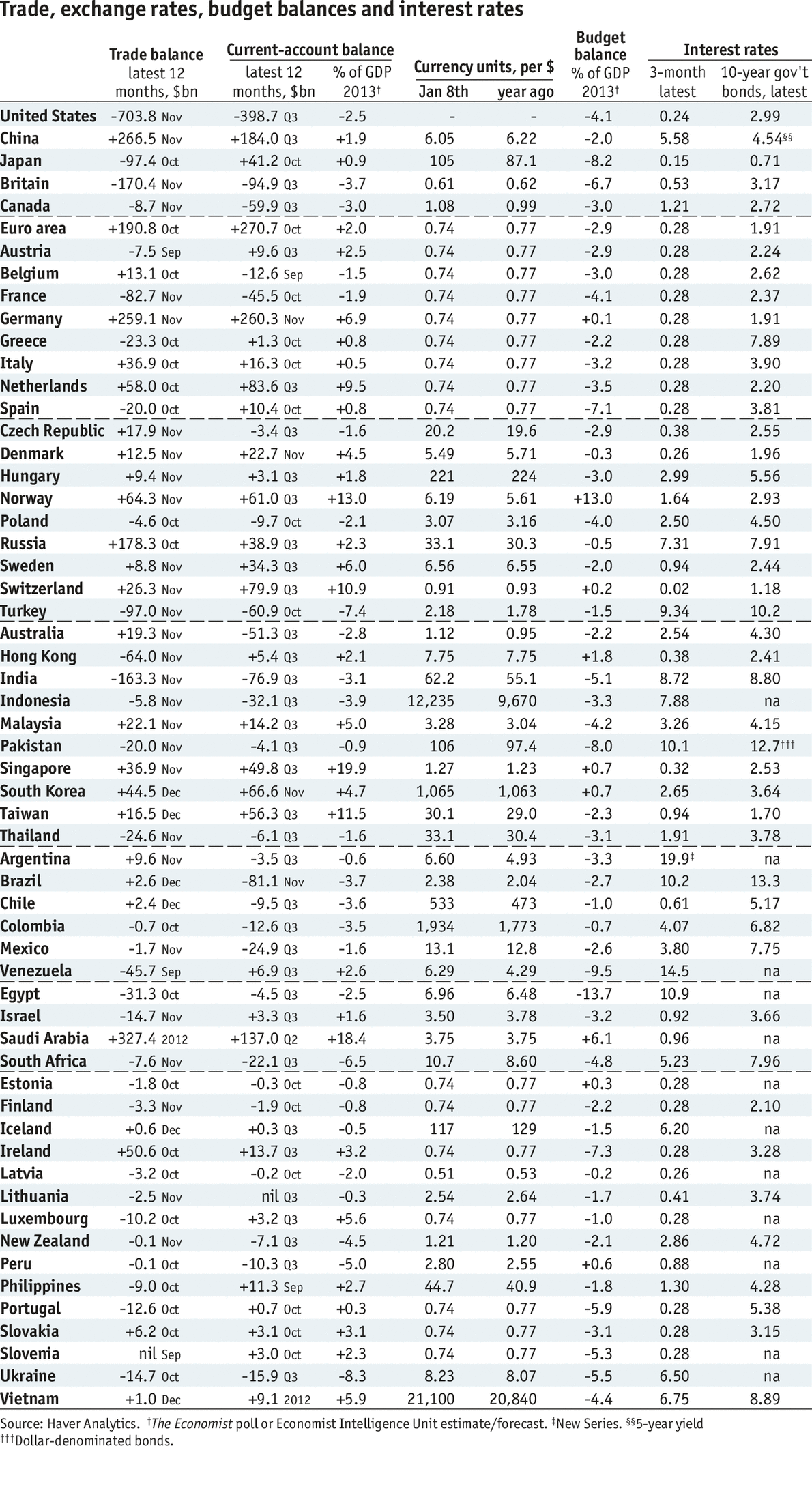
From the attached Economist data table, one can see that the “Fragile Five” do indeed have week external balances. Looking at Brazil, we see a Current Account deficit of 3.7% of GDP and a Budget deficit of 2.7%, almost as bad as the UK’s numbers (3.7 and 6.7), and only slightly worse than Canada’s (3.0% and 3.0%). Most of the famous “PIIGS” have at least one measure significantly worse than the “Fragile Five”, whilst PIIGS Gross Public Debt numbers are all worse than those for the Fragile Five.

I have also attached the Economist‘s Sinodependency index, an attempt to show how dependent large US companies are on China. It would be interesting to see the concept expanded to Emerging Markets in general, and across countries other than the US; Germany’s Volkswagen is the number 1 brand in China currently. The original interactive version is available here.


I am not trying to divert attention away from the significant problems that exist in Emerging Markets; they would not be Emerging Markets if they didn’t have problems. One of the lessons, however, that should have been learned from the Global Financial Crisis was that the differences in risks between Developed Markets and Emerging are less than popularly perceived, not because Emerging risks are lower, but because Developed risks are higher, even if only because of their increased Emerging Markets exposure.

I still remain deeply skeptical of the Euro project; despite all the talk of the various PIIGS being saved, they are still massively in debt, with at least one of their major balances – usually the Budget deficit – still very ugly. The overall Euro area may be in balance but that still cleaves between an almost predatory Northern group, and the moribund Southern group; the “failure-to-launch” of the French Economy puts them firmly in the Southern group. Comments out of the UK about France being the real weak link in the Euro are probably more about British Schadenfreude for all things French, but they do serve to highlight the extent of France's problems.

The Basel III leverage requirements were recently watered down at the insistence of the German and the French Governments because it would have forced their banks to shrink their balance sheets more aggressively than is currently happening; in short, their banks still require massive regulatory forbearance because they have not been cleaned up to the extent of the US and UK banks.

The UK is expected to be the fastest growing major economies in 2014, and should be the first to raise interest rates, but that has come at the expense of a re-inflated housing bubble. It’s only a matter of time before UK TV is again dominated by shows telling everyone how easy it is to make money by flipping properties.

Shadow banking, not just in China, is going to be a major issue this year. As the FT recently reported, “Shadow banking worries extend far beyond China. Paul Tucker, a former Bank of England deputy governor, claimed on Thursday that regulators around the world were struggling to keep up with the pace of change in the “shape-shifting” non-bank sector. He warned of “faltering vigour” in official oversight of global markets.

In a paper published by the US think-tank, Brookings Institution, Mr Tucker said regulators around the world needed to display greater flexibility to cope with “endemic regulatory arbitrage and the shape-shifting dynamic of finance”, pointing to problems in both advanced and emerging market economies.’

So I have to agree with Messrs. Rubenstein and Fink, there is a lot to be worried about, but where can we look for relief?

I actually take comfort from the reduction of QE by the Fed. US house prices have clearly bottomed, and as I mentioned in a previous post, US economic growth is gaining traction. Even if that does not justify the current valuations of the S&P, a stronger US economy can only be a good thing.

Despite my fears of a UK housing bubble, their economy unquestionably has momentum, and, having used unemployment as an early indicator to raise rates, failing to follow through would undermine BoE credibility. I think even a symbolic increase of 1/8th accompanied by the message that the Bank was actively monitoring the effects of the increase on the economy, which they would be doing anyway, would send a very positive message.

The fact the Brazil’s President, Dilma Rousseff, went to Davos on a charm offensive, rather than trying to polish her socialist credentials as in previous years, suggests she at least recognizes the magnitude of her problems. A swift readjustment to imported diesel prices to compensate for the weaker exchange rate would also suggest she is prepared to act. Unfortunately, the World Cup followed by Presidential elections in October mean we are unlikely to see anything more decisive than that. IF, however, she replaces Guido Mantega as Finance Minister in her second term that would really set the markets racing.

Chinese New Year is early this year, starting January 31st. Given that it is always a confusing period for Western observers that is probably a good thing. We have already seen signs of seasonal disruption to Steel inventories, Iron ore shipments, and possibly even the PMI. Currently the prevailing attitude seems to be all news is bad news, so the sooner we can get past these distortions, the better we can understand the real situation, whatever that might be.

Turkey will get a pass. Unless PM Erdogan does something really stupid, he will ultimately enjoy the backing of the US, the EU, and the IMF, despite all the sturm and drange in the meantime. Turkey is too important an ally, and despite Erdogan’s increasingly authoritarian tendencies, the country is firmly on the democratic track. Even 10 years ago the army would have been on the streets by now. I have known Mehmet Simsek, Turkey’s Minister of Finance, for years and he is a VERY safe pair of hands.

Elsewhere, the $7 billion in investments that Enrique Peña Nieto of Mexico managed to secure at Davos shows the benefits of his reform program. I am under no illusions as to the enormity of the task ahead of him in actually implement his program, but he has already made more progress than either Presidents Fox or Calderon, and he seems to be able to forge alliances with the other parties to produce some kind of result.

Sub-Saharan Africa has seen a renaissance in recent years. The commodities boom may have triggered it but it has gained a momentum of its own as local firms, such as Dangote in Nigeria, as well multinationals such as Nestlé and South Africa’s Tiger Brands look to expand. Some of the initiatives, like Kenya’s Mpesa, are truly world class and will continue to drive growth forwards.

Currently I am working on the premise that the first half of 2014 is going to be highly volatile, with at least a major correction across all markets, but I see that correction as being highly cathartic. The kind of correction that would give Merrill's Michael Hartnett his major buy signal, so I am also putting in place my strategies for that spike down.


Sunday, 27 October 2013

Africa Rising


Charles Robertson, the Chief Economist from Renaissance Capital, has written a new book on Africa, called the Fastest Billion. He also got to do a TED Talk about Africa, which has just been released on the Internet.


Firstly, I love TED talks. They manage to get complex and nuanced subjects over with a degree of clarity I love and envy. I often find them a great cure to an addled mind.

This talk was no exception. It was simple and concise, but at the same time highly informative. For me there were three important messages he brought out extremely well.

Inevitability. He put up some excellent charts of GDP per capita showing the way countries have developed, especially since the birth of the Industrial Revolution. They looked remarkably like the charts Hans Rosling produces in GAPMINDER that I referred to in my introductory blog.

Obviously not all countries have historically started to develop at the same time. Local factors may hold them back or push them forwards, such an oppressive political regime or easily usable resources, but once the brakes are taken off and the engine is running, they become near impossible to stop.

It is this inevitability that too many investors miss. I am still shocked how many people I talk to still think about Emerging Markets as if they were some kind of flash-in-the-pan.

Education. I had never seen anything like his chart on education previously. I did not realize that levels in many African nations have reached the same as those we saw in Mexico and Turkey before those countries started to grow. To me this is crucial, because an educated population demands more from its politicians and no longer accepts “business as usual”. They are more able to move beyond mere subsistence living into something more structured.

When I was at university, nearly half my year was from sub-Saharan Africa, which partly explains my interest in Emerging Markets. Many had gone to British Public Schools prior to university, and the majority of them were returning home afterwards, so I should have been more tuned in to the rising educational standards.

When I first started investing in Latin America in the early 90’s, part of the argument was that there was a whole army of bright young graduates from the region who had been educated in the Developed Economies and were now returning home to use that education and to participate in the opening up of the economies. If it worked in Brazil and Mexico, why not Nigeria and Ghana?

Speed. Possibly the most contentious point he made was that Africa would now grow faster than other regions had previously. I cannot point to any empirical evidence to support that conjecture, but….

I think it was Jared Diamond in his book Guns, Germs, and Steel who explains how physical geography can affect the development and transmission of ideas; People who live in mountainous jungles are less likely to invent the wheel than people who live in more open areas. The cultivation of domesticated crops can spread more easily along lines of latitude than longitude because climate tends to be more constant.


That has probably been true over thousands of years of human history, but not so today. Today ideas can flash around the world at quantum speed. Changes to productivity that used to take decades, if not centuries can now happen in a few short years. We assume that countries will go through the whole development process the way we did, but forget that they can just buy the same technology that we have off the shelf.

I am almost the transition generation between what we might call low technology and high technology. As Douglas Adams put it in a Hitchhikers Guide to the galaxy, when I left school people used to think that digital watches were a pretty neat idea, my school was the only one in the country with a computer, and my A Level class was the first to be allowed hand calculators in the final exam.

When I was a graduate trainee, company meetings were dominated by discussions of the strategic importance of Information Technology. It soon dawned on me that it was actually a zero-sum game. Most people were following near identical strategies, whilst those that delayed would just buy the next upgrade in 6-12 months time.

A few years later, when I started travelling to Latin America regularly, it was almost like watching a Conquistador plague laying waste to Middle Management. Empty offices large enough to hold dozens, if not hundreds, of people now held 10, everyone else replaced by computers. Not clunky Brazilian import substitution computers, but the same as, or better than, I had under my desk in London. Running the same Excel or Word.

In the late 90’s, I travelled to Brazil with my then boss, and he asked the banks about their operation, and it soon became apparent to him that in many ways they were more advanced technologically than Canadian banks, with same day cheque clearing anywhere in the country, and seamlessly integrated internet and regular banking.

When I was in Bougainville last year, we passed a Cell tower that obviously had been pulled down. I my ignorance I assumed it was a tribal dispute, but no. We were informed that a local Chief had ordered its destruction after he discovered his daughter had “sexted” pictures of herself to her boyfriend!

When MTN started building its cellular operations in Nigeria, they did not start with the old analogue technology of my first cell phone, but with the latest GSM that they were installing in South Africa. M pesa in Kenya is regarded as the global standard for mobile money transfer.

So yes, I believe Africa will benefit from this acceleration of ideas. It seems that each wave of development has been faster than the one before, as each learns from the previous wave.

And worse case, that Africa’s growth will only be in line with other development waves, still points to a number of very exciting decades ahead.